
Where to Use Video Testimonials Once You Have Them: 8 Places
Most video testimonials die on a hard drive. The rest get posted once, collect a few likes and disappear.
If you are wondering where to use video testimonials once you have them, start here. Put your best clip directly above the button you want people to click. Then send it, email it, post it, upload it and anchor a blog post on it, so the same story shows up everywhere a buyer looks.
🎬 How to Turn 1 Testimonial into 10+ Pieces of Content
Key takeaways
- Put the on the fence answer, 60 to 90 seconds, directly above your call to action button.
- Send that clip to any prospect who hesitates. Let a peer close the deal.
- Every interview becomes 1 full video, 3 short clips, 1 quote and 1 blog post.
- Use it in 8 places: your button, sales calls, proposals, nurture emails, social, YouTube, a blog post and retargeting ads.
- Organize clips by objection, not by date, in a Reinforcer Document.
Where should you use video testimonials?
Put the answer to the on the fence question directly above your call to action button. Then send that clip to prospects who hesitate, add 2 to 3 clips to every proposal, put 1 in every nurture email, cut short clips for social, upload the full interview to YouTube, build a blog post around it and run it as a retargeting ad.
That is 8 places from 1 conversation.
One story, everywhere
The worst thing you can do with a great testimonial is leave it in one place.
Most business owners who do collect testimonials put the video on their sales page and call it done. It sits there, seen by a fraction of the people who need it.
I built the Testimonial Waterfall System on 1 principle: one story, captured once, should flow into every channel your business touches.
The rule is simple. Every interview becomes:
- 1 full video
- 3 short clips
- 1 quote
- 1 blog post
One customer's truth becomes a month of marketing.
There is a reason this matters more than another ad. Ads rent attention. Testimonials own it. A customer's voice stays an asset long after a salesperson leaves or a website gets redesigned.
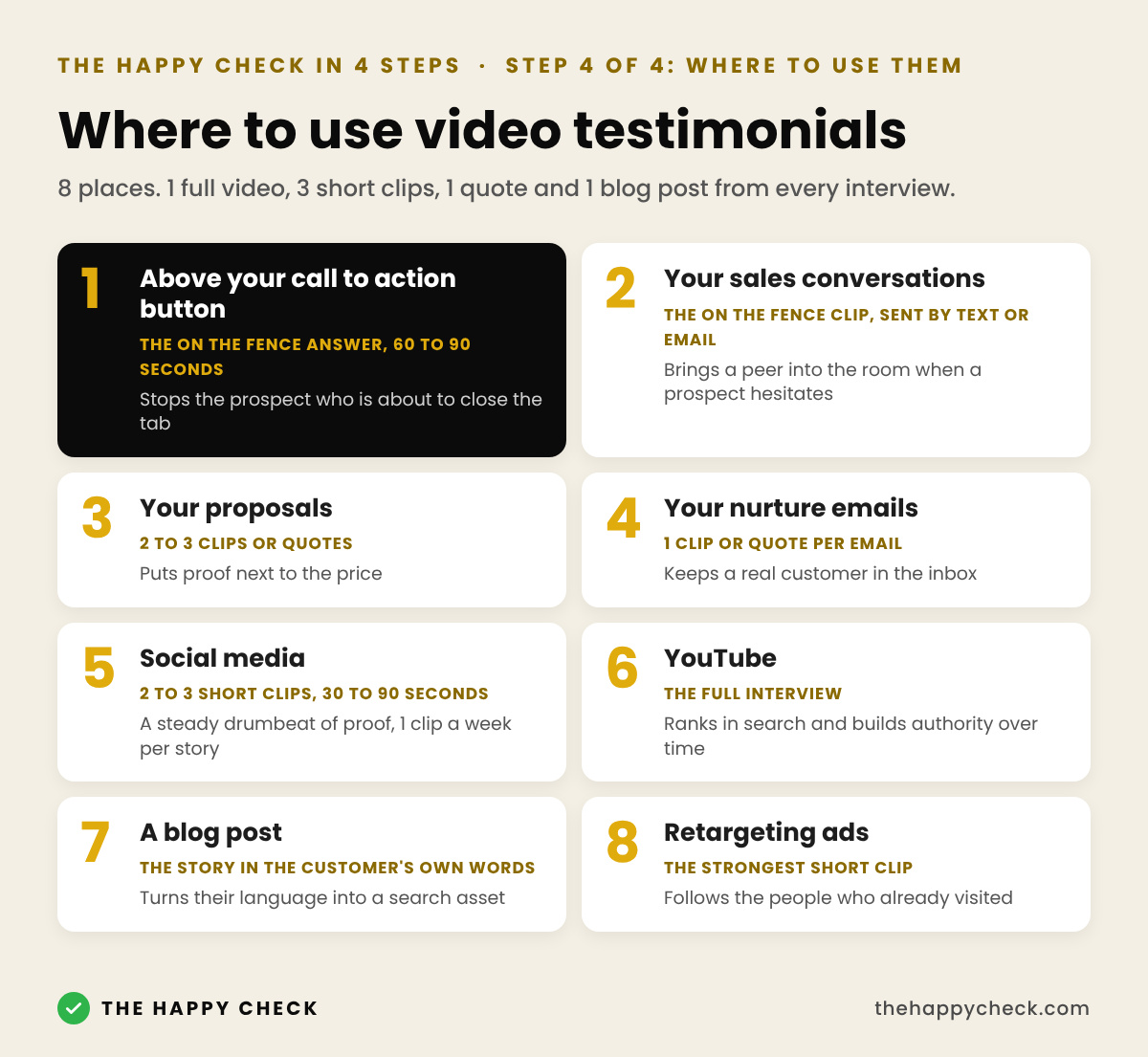
The 8 places, at a glance
| # | Place | Which cut | What it does |
|---|---|---|---|
| 1 | Above your call to action button | The on the fence answer, 60 to 90 seconds | Stops the prospect who is about to close the tab |
| 2 | Your sales conversations | The on the fence clip, sent by text or email | Brings a peer into the room when a prospect hesitates |
| 3 | Your proposals | 2 to 3 clips or quotes | Puts proof next to the price |
| 4 | Your nurture emails | 1 clip or quote per email | Keeps a real customer in the inbox |
| 5 | Social media | 2 to 3 short clips, 30 to 90 seconds | A steady drumbeat of proof, 1 clip a week per story |
| 6 | YouTube | The full interview | Ranks in search and builds authority over time |
| 7 | A blog post | The story and the customer's own words | Turns the customer's language into a search asset |
| 8 | Retargeting ads | The strongest short clip | Follows the people who already visited |
1. Directly above your call to action button
This is the most valuable 90 seconds you own.
Clip your customer's answer to "What would you tell someone who is currently on the fence about hiring us?" Keep it 60 to 90 seconds. Put it directly above your main button: book a call, get a quote, join.
When a prospect is about to close the tab, a real customer stops them.
Embed the full interview on your home page or service page too. The full version is for the person who wants the whole story. The on the fence clip is for the person standing at the door.
Here is the kind of answer that belongs there. Kristina of Ava's Hope Chest, answering that question about Keith at Sundanced Wood:
"Have no worries. He will do what you want, and it will be beautiful."
2. In your sales conversations
When a prospect hesitates, don't explain harder. Say this:
Let me send you a two minute video from someone who was exactly where you are right now.
Then send the on the fence clip and let the customer close the deal for you.
Explaining your methodology one more time adds words. A peer who was on the same fence adds certainty.
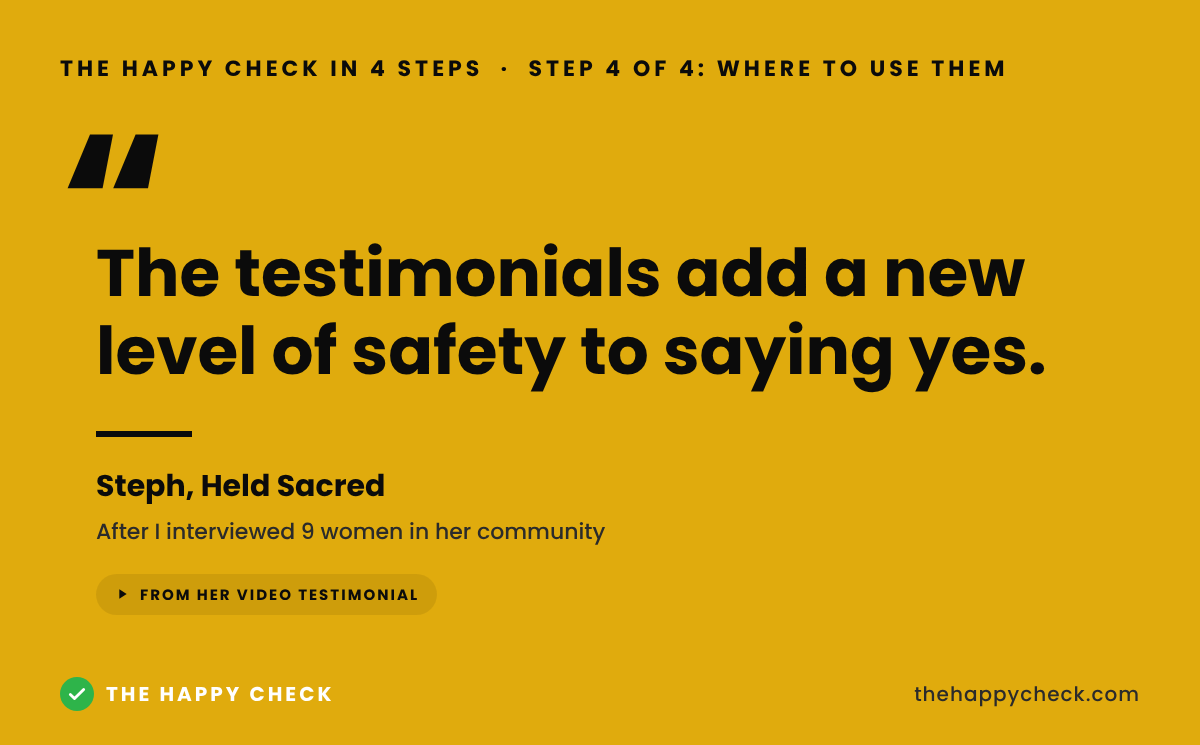
Steph Stanton runs Held Sacred, a community for women. After I interviewed 9 of her members, she had a link to their testimonials to send along with her page. Here is how she described sending it to a woman who was interested:
"Yesterday I sent my website page copy to an interested woman for Held Sacred and I don't know if she saw the testimonials, but just the feeling in me when I sent that page with the link to the testimonials, I felt like this is so much more than enough to have it seal the deal for her."
The woman's answer, as Steph told it:
"Yeah, I'm totally in. This is what I need."
Want your customers' stories captured and put to work for you? Book a Consultation
3. In your proposals
Add a section to every proposal called What Our Clients Say. Put 2 to 3 embedded clips or transcribed quotes in it.
A proposal with proof beats a proposal without it. The prospect reads your price and sees a customer who already said yes to it, and was glad they did.
Pick the clips by objection, not by date. More on that below.
4. In every nurture email
Put 1 testimonial clip or quote in every nurture email. Frame it like this:
Here is what happened when [Name] stopped waiting.
Your subscriber stops hearing only from you. They start hearing from people like them.
5. On social media
Cut 2 to 3 short clips from every interview, 30 to 90 seconds each. Post 1 clip a week per customer story. Label each one simply:
Here is why [Name] chose us.
That is a steady drumbeat of proof, and it reaches people you could never reach on your own.
Kerrie Fleming, a lightworker who does energy work, put it better than I can. On why her clients' videos reach people she can't:
"They could say it better than I can because I'm just the conduit but they are the receiver."
6. On YouTube
Upload the full interview as its own YouTube video. Title it with the result first, then your business:
[Result] | [Your Company] Client Story
These videos rank for search terms and build authority for years, long after a social post fades.
For one of my roofing clients, the 5 video testimonials we captured with the new questions became the bedrock of their marketing: the foundation of the new website I built for them and the first 5 videos on their new YouTube channel.
For Sundanced Wood, Keith's hand carved sign shop, I took over his YouTube. 28 days in, his channel had 1,510 views and 37 new subscribers. Real craft and real customers, compounding instead of spiking once.
7. In a blog post
Every testimonial is also a search asset, and most business owners never use it that way.
The way your customer describes their before is the way their peers type it into Google. A client who says "I kept creating content but no one was buying and I felt invisible online" is speaking the exact words of someone searching "why is my content not converting."
So build a blog post around each story. Tell it in full, embed the video and quote the customer's own words.
We built Keith's Sundanced Wood website on his real customers' words and his own artwork. No templates. No filler. In its first 60 days with the new site and its foundational SEO, 138 people found him and the site logged 972 tracked interactions.
8. In retargeting ads
This is where my own business turned.
When I first started collecting video testimonials inside a trades company, the videos were so strong that I shut down every ad campaign we had except retargeting. And the retargeting ran on those customer videos.
People who had already visited saw real customers talking about why we were better than the competition. That is a different ad than a logo and an offer.
Organize them by objection, not by date
As your library grows, posting in the order you recorded stops working. You need to find the right clip in the 30 seconds after a prospect says "I'm not sure."
That is the Reinforcer Document: a living library of every testimonial, clip and quote, organized by the objection it dissolves. Build it in a Google Sheet.
Here is what a few rows look like, built from the customers in this series:
| Objection a prospect raises | Clip or quote to send | Customer |
|---|---|---|
| "I'm not sure it will come out the way I picture it." | "Have no worries. He will do what you want, and it will be beautiful." | Kristina, Ava's Hope Chest (for Sundanced Wood) |
| "Is a custom sign worth it?" | "This sign paid for itself within about a week of me putting it up." | Kristina, Ava's Hope Chest (for Sundanced Wood) |
| "Will testimonials make a difference for a community like mine?" | "The testimonials add a new level of safety to saying yes." | Steph Stanton, Held Sacred |
| "I'm not sure your interviews get anything different from what I could get myself." | "Mark, you have a way of really asking questions and going deeper into not getting the generic answers." | Kerrie Fleming |
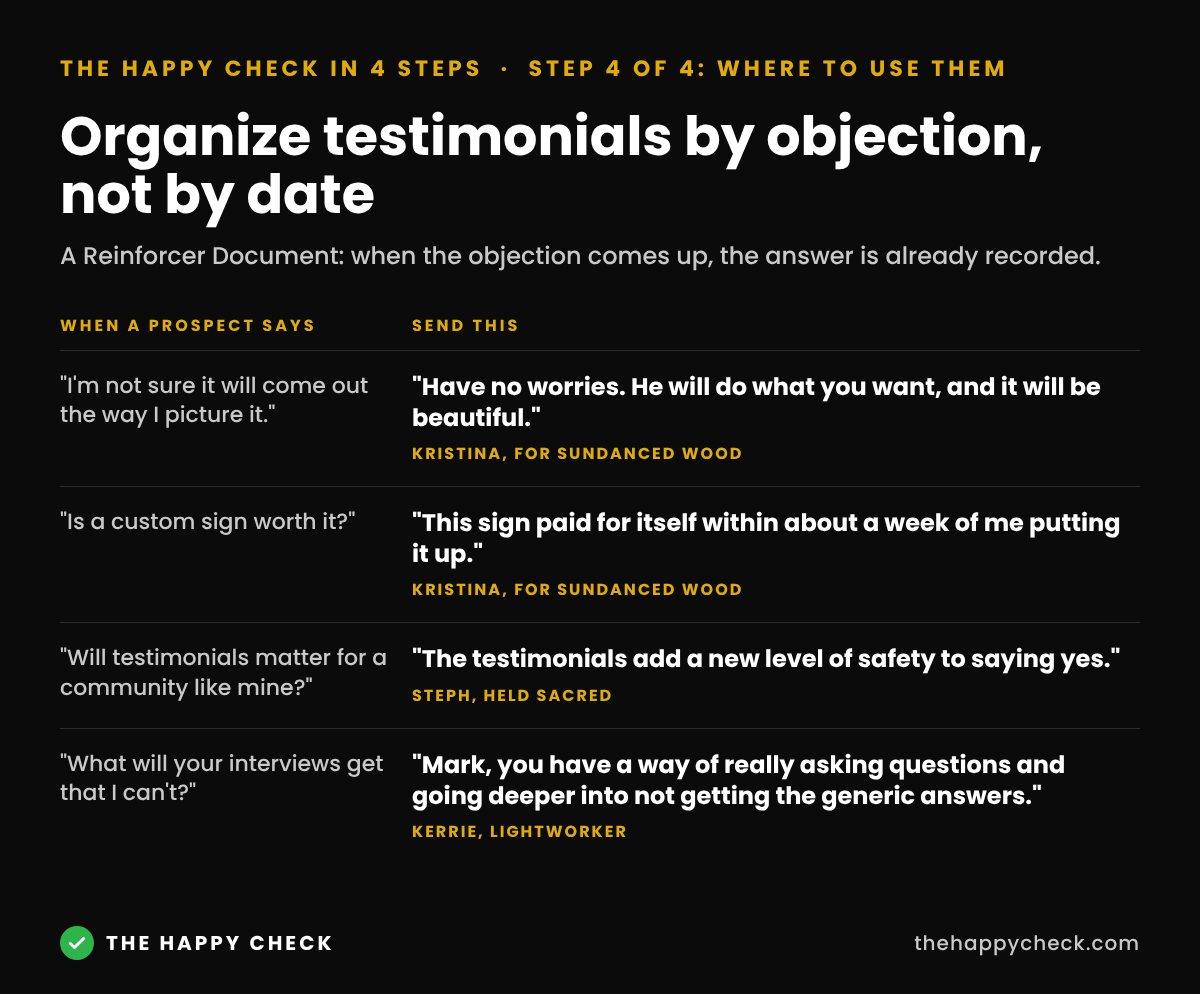
Every row is ammunition. When the objection comes up, the answer is already recorded, in someone else's voice.
What this does for you, not just your marketing
Here is the part nobody expects.
Steph told me what having her members' testimonials out in the world did for her:
"So having the testimonials as this feeling of safety that goes out is to me, worth 10 times what I paid you. I don't have to do the heavy lifting anymore to show that this group is valid."
And:
"Yes, I've gotten new clients since you created the testimonials or you gathered the testimonials."
When your customers' words are everywhere a buyer looks, you stop being the only person making the case for your work.
Start with 1 this week
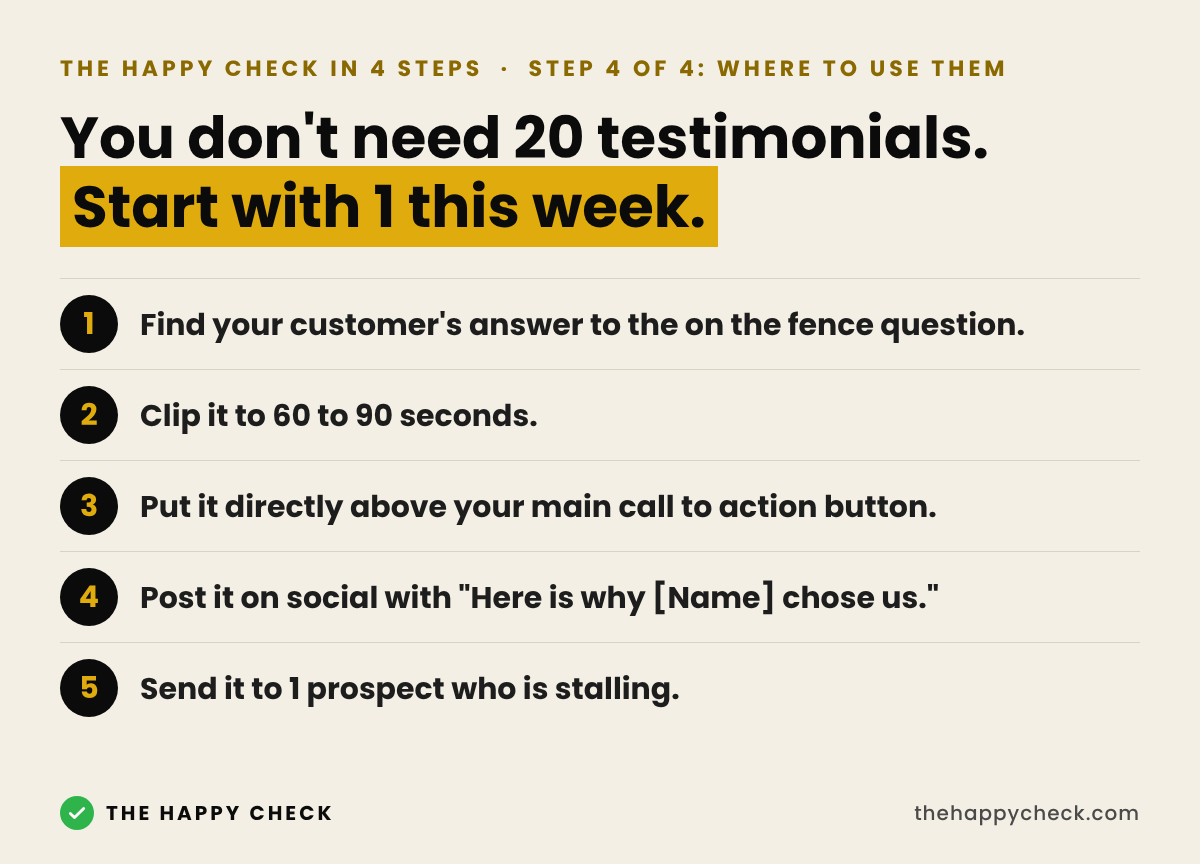
You don't need 20 testimonials. You need 1, placed well.
- Find your customer's answer to the on the fence question.
- Clip it to 60 to 90 seconds.
- Put it directly above your main call to action button.
- Post it on social with "Here is why [Name] chose us."
- Send it to 1 prospect who is stalling.
Then do the same with the next one. The Waterfall feeds itself: the first story builds trust, trust brings the next customer, and the next customer is your next interview.
Don't have the video yet? Start with when to ask for a testimonial, then how to ask a customer for a video testimonial and what to ask when they say yes. Want the full system behind this post? Here is the Testimonial Waterfall. And you can see the client stories this all came from.
Your next 5 customers are hiding inside your last 5.
Questions business owners ask about using video testimonials
Where should I put video testimonials on my website?
Directly above your main call to action button, using the answer to the on the fence question. Embed the full interview on your home page or service page for people who want the whole story.
How long should a testimonial clip be?
60 to 90 seconds for the clip above your button and the clip you send to prospects. 30 to 90 seconds for social. The full interview goes on YouTube and your site.
Should I post the full interview or short clips?
Both, in different places. Short clips on social and above your button. The full interview on YouTube and a blog post, where people who want the whole story can find it.
How often should I post testimonials on social media?
1 clip a week per customer story. 1 interview gives you 2 to 3 clips, so a single conversation covers most of a month.
Do I need permission to use a customer's video testimonial?
Yes. Get their okay in writing before it goes anywhere, and only use it the way they agreed to. I track consent for every person I interview.
Want this done for you?
Kerrie Fleming, on working with me:
"I recommend anyone to at least make an initial phone call with him and find out who he is, what he is about."
If you are done being the only person making the case for your work, let's talk. Book a consultation and we will see if a marketing partnership is a fit.
Mark Crandall
Founder, Scale to Sale Consulting & The Happy Check
Mark Crandall has a master's in social work and practiced therapy with youth and families for about 10 years before moving into sales and marketing. He uses that training to help business owners collect unscripted customer stories on video.
Ready to Stop Doing All The Heavy Lifting Alone?
Capture your first 5 unscripted customer video stories and turn them into your dominant marketing assets.